FootNet: Deep Learning Emulator for Atmospheric Transport
Full physics atmospheric transport models (e.g. STILT, Flexpart etc.) are computationally expensive as well as storage intensive for high-resolution dense observing systems. Here we developed a deep learning emulator for atmospheric transport (FootNet) which is based on U-Net++ architecture. FootNet is trained on half a million footprint outputs from STILT simulations. FootNet computes a footprint 1000x faster than a full physics model and provides a 650x speed up in estimating GHG emission sources using flux inversion. Footprints can be computed on-the-fly with FootNet, which allows for real-time and scalable GHG emission monitoring at high-resolution with dense observing systems.
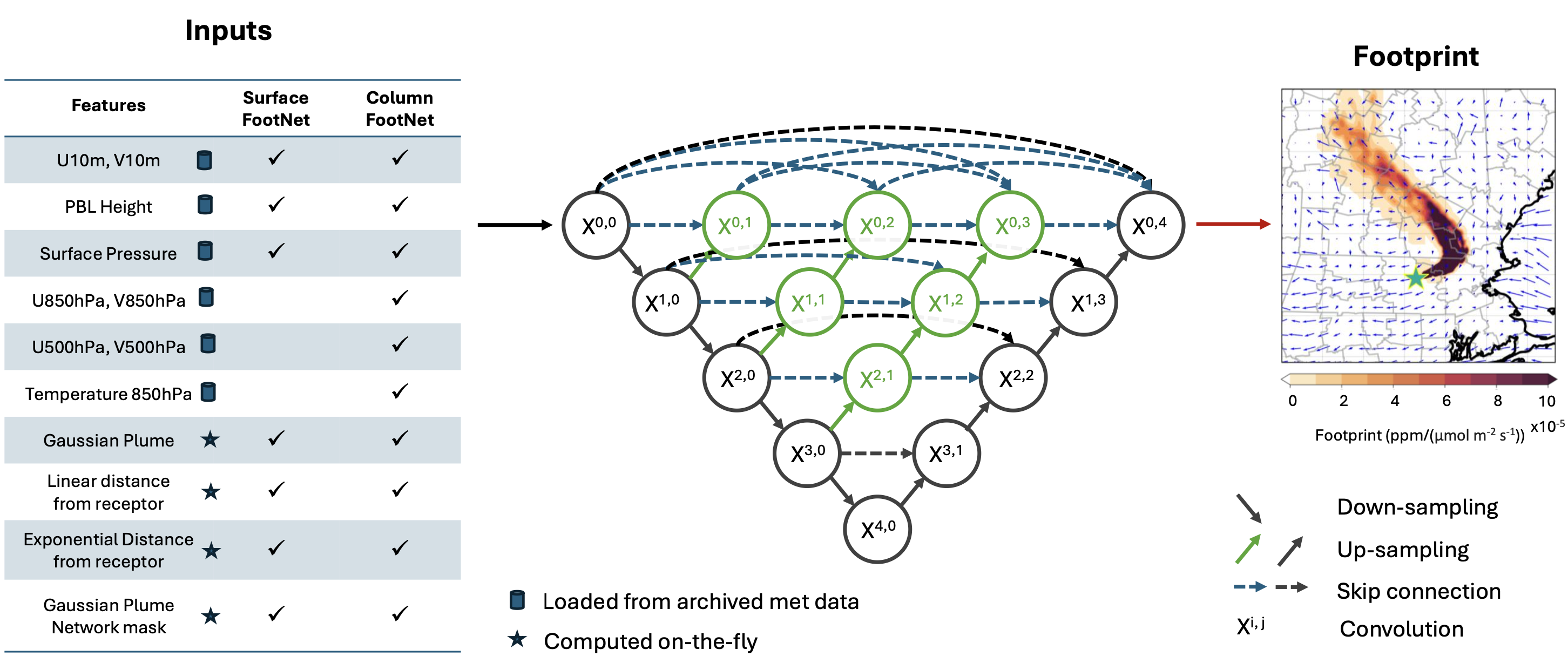
Fig. FootNet model architecture along with inputs and output of the model.Citations
Dadheech, N., & Turner, A. J. Simulating out-of-sample atmospheric transport to enable flux inversions. Atmospheric Chemistry and Physics, 26(1), 427-441. PDF
Dadheech, N.*, He, T. L.*, & Turner, A. J. (2025). High-resolution greenhouse gas flux inversions using a machine learning surrogate model for atmospheric transport. Atmospheric Chemistry & Physics, 25, 5159–5174.* equally contributed authors. PDF
Dadheech, N*, He, T. L.*, Thompson, T. M., & Turner, A. J. (2025). FootNet v1. 0: development of a machine learning emulator of atmospheric transport. Geoscientific Model Development, 18(5), 1661-1671. * equally contributed authors. PDF